System Architecture & Continuity Research
We build open architectural blueprints and technical dependency maps to eliminate single-point deadlocks during complex multi-tier infrastructure incidents.
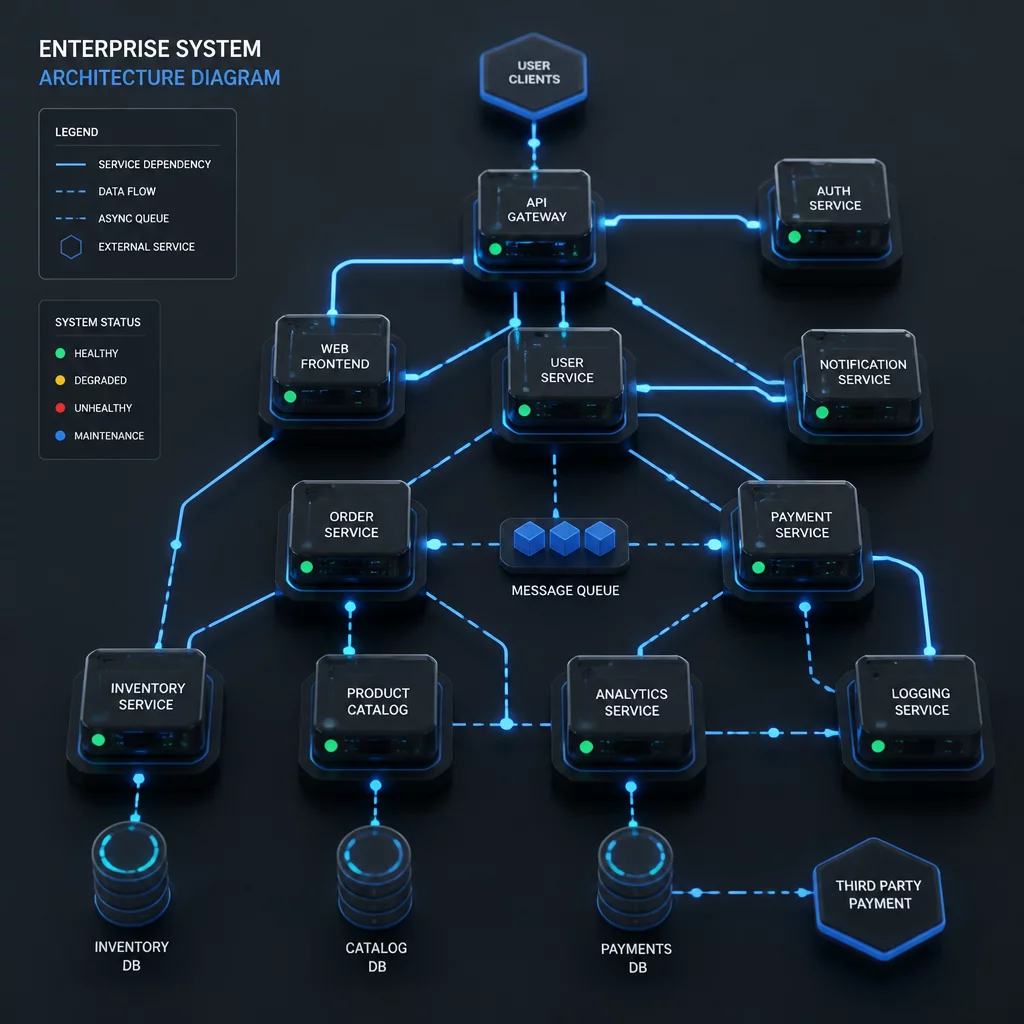
Architectural Continuity and Order of Operation
Modern enterprise systems do not fail in isolation. When critical infrastructure undergoes catastrophic failure, bringing machines back online in the wrong sequence leads to authentication deadlocks, broken cryptographic chains, and orphaned transactional pipelines.
The Atlas was engineered by infrastructure systems engineers to bridge the gap between simple image backups and multi-tier operational readiness. We document, analyze, and publish formal dependency maps that define the precise sequence required to return mission-critical nodes to complete readiness.
Cataloging core identity, DNS, and root security modules that must precede application startup.
Isolating hidden upstream dependencies across hybrid cloud and bare-metal environments.

Empirical mapping of core system links, identity pipelines, and storage fabrics.
Who This Atlas Is For
Our dependency blueprints serve the practitioners who must answer what has to be available before a restored system can actually work again.
System Administrators
Validate boot sequences and service prerequisites.
IT Operations
Coordinate cross-tier restore order and workload checks.
Infrastructure Teams
Map identity, network, storage, and app dependencies.
Disaster-Recovery Planners
Document dependency order and verification criteria.
MSP Teams
Standardize recovery sequencing across client estates.
Foundational Methodology
Our research analyzes infrastructure vulnerabilities through three primary technical frameworks.
Strict Sequence Mapping
Every system maintains an explicit Directed Acyclic Graph (DAG) detailing boot order prerequisites, key management services, and certificate lifecycle anchors.
Empirical Incident Analysis
We dissect real-world production outages where image backups succeeded technically but operations remained paralyzed due to unmapped external dependencies.
Readiness Validation
Providing engineering teams with automated checklists and readiness matrices designed to expose circular dependencies before an actual disruption occurs.
Interactive Framework Explorer
Select an architectural tier to inspect readiness criteria and sequencing priorities.
Core Security and Directory Nodes
Tier 0 components represent the ultimate zero-point dependency. If Domain Controllers, Key Vaults, NTP clocks, or DNS authoritative servers are offline, all downstream systems will reject credentials and fail to mount network shares.
- Active Directory Domain Services / LDAP
- PKI & Internal Certificate Authority
- Authoritative DNS & DHCP Infrastructure
Research Resources & Case Studies
Explore our documented dependency matrices, guides, and engineering investigations.
Dependency Maps
Comprehensive architectural maps outlining service chains, quorum nodes, and startup constraints.
Featured Case: The Server Was Restored, but Nobody Could Sign In
An in-depth post-mortem on active directory trust boundary desynchronization following image deployment.
Recovery-Dependency Review for Teams Using Macrium Reflect
Practical review of disk-level image workflows and critical cross-system dependency alignment.
Have Inquiries About Infrastructure Topological Sequencing?
Connect with our systems engineering team to discuss dependency analysis standards and readiness frameworks.